Guides
How to be an AI-native business
David Buxton · · 4 min read
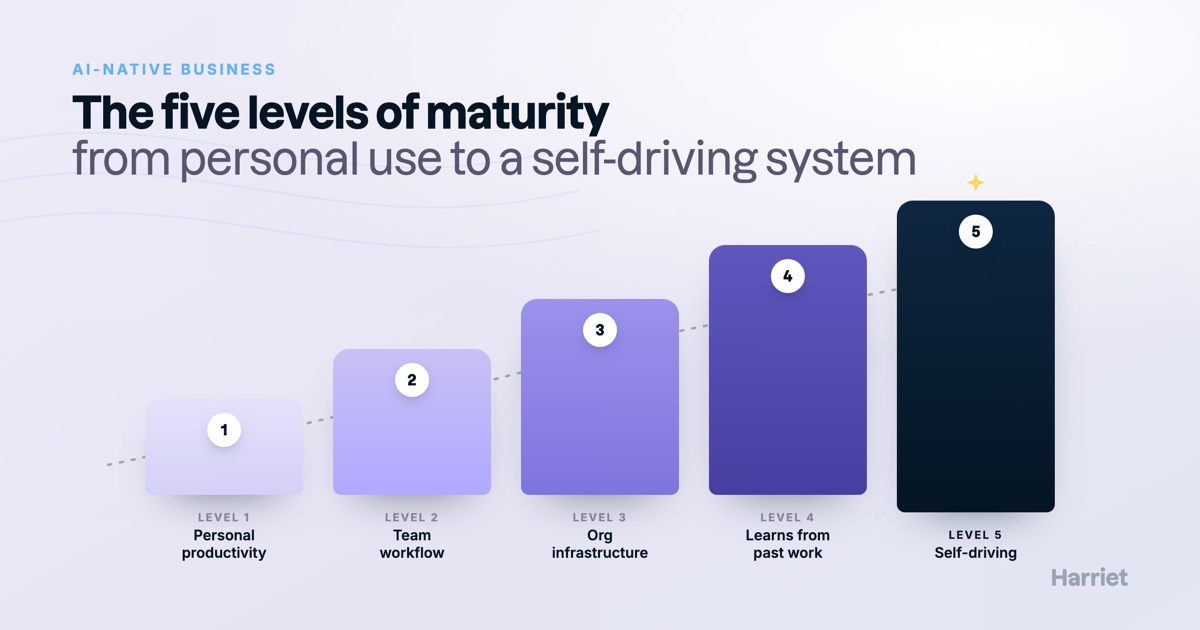
How do you actually become an AI-native business? Start by dropping the idea that “AI-native” is a badge you either have or you don’t. It’s more like self-driving cars: there are levels. Knowing which one you’re on tells you exactly what to do next.
First, what is an AI-native business? The 5 levels
An AI-native business sits somewhere on a five-level spectrum, from individuals quietly using AI to a system that runs work on its own.
Level 1 — personal productivity
People use ChatGPT or Claude to draft emails, summarise meetings, brainstorm, maybe build a dashboard nobody asked for. Useful, sure, but the workflow lives entirely with the individual. Good luck measuring the ROI.
Level 2 — team workflow
Sales has its own AI prospecting setup, support has AI triage, HR has AI-assisted hiring. Every team is building its own little stack, and none of them talk to each other.
Level 3 — organisational infrastructure
Here it gets interesting: infrastructure that sees across the whole company. It can query contacts, compound context, and work across functions instead of staying trapped in one team’s tools.
Level 4 — a system that learns
This is where things start to compound. The company isn’t just using AI — the system learns from previous work. It improves workflows over time and lets non-engineers build real shared skills without waiting on an eng team.
Level 5 — the self-driving endpoint
The system notices something important on its own, synthesises context, decides what to do, takes action, escalates when it needs a human, and updates a shared memory so the next decision is better than the last.
The level that actually matters in 2026
It’s a genuinely useful framework, and figuring out where you sit on it is a good chunk of any honest AI diagnostic. But most companies should not be fixating on Level 5 right now. It isn’t realistically on most people’s roadmap for 2026.
The actual bottleneck for almost everyone is getting from personal productivity (Level 1) to real team and cross-functional execution (Level 3). That’s the gap that matters this year — not the sci-fi endpoint.
How to be an AI-native business: 5 steps
You don’t leap to AI-native. You climb. Here’s the shortest path that holds up.
- Diagnose your level. Be honest about where you actually are on the five levels above. Most companies discover they’re a scattered Level 1 pretending to be higher.
- Aim for Level 3, not Level 5. Cross-functional infrastructure is the prize this year. Autonomy can wait until the foundation exists.
- Put AI where the work already happens. Resist the rush to build a pile of specialised internal apps. In practice that creates brittle tools and fragmented permissions — every new app is another place to decide who gets access to what data, who administers it, and who maintains it when the underlying model or API changes. Multiply that by every team and you’ve built a maintenance problem, not an AI strategy.
- Route each job to the right model. Send the routine 80 percent to a cheap model and the hard work to a frontier model, under one set of cost controls and one bill. (It’s the same reason you shouldn’t bet the company on a single model — lock-in is lock-in.)
- Close the gap between insight and action. Dashboards and data lakes help you see the work; they don’t move it. The unlock is AI that acts, not just reports.
The real unlock: from insight to action
Our take at Harriet is that AI should operate inside the workspace you already use — your docs, spreadsheets, browser, calendar, internal systems — rather than inventing yet another place for it to live. Visibility alone isn’t the win.
The real unlock isn’t more visibility. It’s closing the gap between insight and action.
That’s the whole reason we built the AI control plane: governed AI that works across functions, on infrastructure IT already trusts. See how it fits together on the platform, or book a call to work out which level you’re actually on — and the fastest way up.